


Talk to us today about your Forged Fittings Requirements.
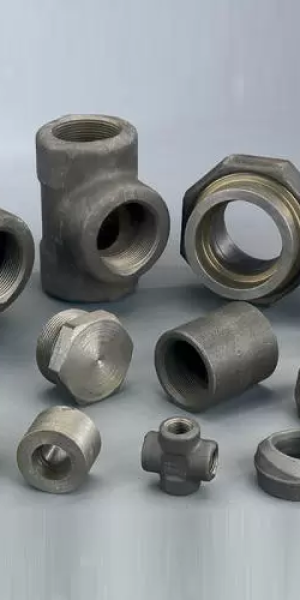
Forged Fittings
What are Forged Fittings?
Forged fittings, as the name implies, are forged out of steel, stainless steel, duplex, super duplex, or 6% moly. Forging entails forcing metals through a pressure press that transforms metal into something incredibly stronger than other types of casting. Thus, the use of forged pipe fittings leads to applications within industries requiring higher strength levels and mechanical durability.
Forged fittings are produced in a variety of shapes and configurations to accommodate various needs. Some of these include:
- 45° Elbows
- 90° Elbows
- Straight and Reducing Tees
- Couplings
- Half Couplings
- Caps
- Plugs
- Crosses
Manufacturing of Forged Fittings
This is a labor-intensive process that requires several processes to get the final forged fitting for piping systems right.
A steel billet is acquired and accurately cut into blank shapes to fit the desired fitting. After cutting the billet, it is heated to the proper temperature for forging. This process shapes the billet to the desired geometry. The heated billet is put into molds called dies to assume the final form. The excess material is removed, and the fitting is cut to the appropriate size. Punching and correction are done to make the small adjustments necessary to have a proper fit and finish.
Forged steel pipe fittings are heat treated to enhance mechanical properties. Every fitting undergoes a string of rigorous tests, such as chemical composition, mechanical properties testing, and NDT to ensure the highest quality. Once the fittings pass the final inspection, they are ready to be used in demanding environments.
Applications of Forged Fittings
Forged fittings are highly versatile and are used in a wide range of industries. Some of the most common applications include:
- Tees and Reducing Tees: Tees are utilized to join or split the flow of liquids while reducing tees allow for a change in the size of a pipe.
- Elbows: Elbows are the most common fittings used to change the direction and size of the piping system. This is mostly in the form of 45° or 90°.
- Couplings: Couplings connect two lengths of pipe, either by threading one end or welding the other.
Advantages of Forged Fittings
1. Higher Strength:
The grain structure in forged fittings is tighter, and therefore, they are mechanically stronger and more resistant to high pressure.
2. Less Risk of Defects:
Unlike other fittings, which suffer from porosity, shrinkage, and cold pours, the forged pipe fittings do not have any such defects and are therefore more reliable.
3. Better wear resistance:
Forged fittings for piping systems provide better wear resistance due to the unique microstructure. They will not easily get brittle or break down in demanding conditions.
Quality Assurance Up to International Standards
At Hatco, we source forged fittings with the most responsible manufacturers in this industry. In our case, all products that are supplied come through a thorough quality control inspection to ensure full compliance with these standards.
- ASTM Standards: ASTM 182,
- ANSI Standards: ANSI B16.11
- MSS Standards: MSS SP43, MSS SP75.
Our Stock Range
- Super Duplex Steel (UNS S32750, UNS S32760)
- Duplex Steel: (UNS S31803, UNS S32205)
- 6% Moly Steel: (UNS S31254) also referred to as 254 SMO
- Stainless Steel: (316L 316L, 304L , 904L)
Forged Fittings Procurement from Hatco
Specializing in offering varied forged steel pipe fittings to ensure quality, performance, and durability, Hatco holds a rich competence in the given areas of fittings. It goes without saying that any industry – petroleum, gas, petrochemicals, and water treatment is not excluded either – that could be dealing with high-pressure environment-friendly corrosion-resistant properties.